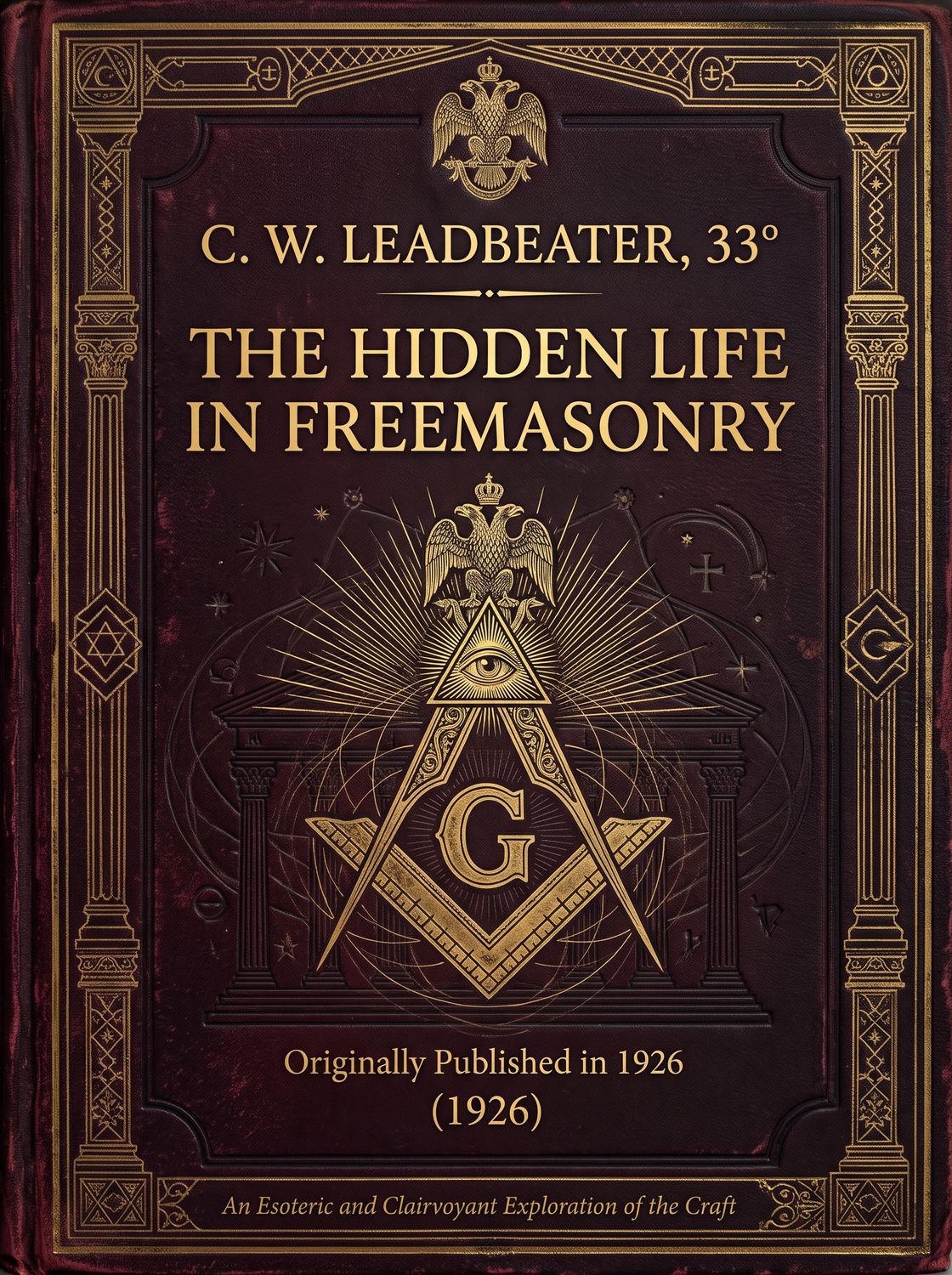
Cinematic series of each chapter
Pay what you want
0 or more
$
Free or your own price
In stock
1
Save this product for later
Cinematic series of each chapter
Product Details
The Hidden Life in Freemasonry (1926) by Charles Webster Leadbeater (33°) is an esoteric study that examines Freemasonry through the lens of clairvoyant occultism, sacred geometry, and theosophical spiritual science.
Leadbeater argues that modern Freemasonry is neither an arbitrary invention of medieval stonecutter guilds nor merely a philanthropic club teaching an elementary moral code. Instead, he asserts that the Craft is a direct, living survival of the Ancient Mysteries of Egypt, functioning as a practical sacramental mechanism to stimulate human spiritual evolution and channel divine energy into the world
1. The Core Thesis: Freemasonry as Ancient Spiritual Science
- Antiquity and Lineage: Leadbeater claims that Masonic ceremonies date back thousands of years to ancient Egypt. Based on what he describes as his own clairvoyant recall of a past incarnation in Egypt around 4000 B.C., he maintains that the layout of the lodge, the placement of the three principal officers, the signs, knocks, and steps are virtually identical to the rites of the Egyptian Mysteries He supports this claim using the archaeological and symbolic research of Masonic scholars such as Albert Churchward, John Yarker, and J. S. M. Ward.
- The "Sacramental System": Quoting W. L. Wilmshurst, Leadbeater frames Freemasonry as a sacramental system possessing an outward visible ceremony that conceals an inward, spiritual reality. Rather than empty formalities, Masonic actions serve as a "splendid science and a reservoir of power" designed to uplift humanity.
2. The Mechanics of the Lodge: Thought-Forms, Angels, and Spiritual Force
A major focus of the book is how a Masonic lodge functions on the unseen etheric, astral, and mental planes:
- The Generation of "The Hidden Light": The central Egyptian doctrine was that a divine spark—the "Hidden Light"—dwells within every human being. The purpose of Masonic labour is to bring down high spiritual forces, condense them within the lodge, and project them into the surrounding community to fan that divine spark into flame.
- Masonic Magic vs. Christian Sacraments: Leadbeater draws an extensive parallel between the Christian Eucharist and Masonic work. While the Christian Mass relies principally on the solitary action of the priest to invoke higher angelic powers, the Egyptian/Masonic method requires the conscious, coordinated cooperation of every officer and brother in the lodge.
- Angelic Hierarchies: During the opening of the lodge, invisible elemental and angelic orders are summoned. These beings assist in erecting a protective etheric "thought-form" or storage battery over the temple to concentrate the invoked spiritual energies and prevent them from dissipating.
3. Esoteric Anatomy: Chakras and the Subtle Bodies
Leadbeater details how the clothing, tools, and gestures of the degrees directly impact the candidate’s subtle physiology:
- Awakening the Force-Centres (Chakras): The human etheric double contains seven force-centres (chakras) resembling saucers or flower bells rooted along the spine. Masonic steps, signs, and tokens are deliberately designed to stimulate these centres in a specific developmental order, beginning with the throat centre in the First Degree.
- The Belt and the Apron: In the ancient Egyptian system, the belt of the apron was not an ornamental string, but a magnetized circle creating an etheric disc across the waist. This protected the candidate by insulating his lower passions from the high spiritual currents generated during the lodge's work. The flap of the apprentice apron (turned upward as a five-pointed figure) symbolizes the higher triad/soul hovering over the lower quaternary/body before fully descending into it in the later degrees.
4. Progression of the Degrees as Spiritual Evolution
The book systematically breaks down the symbolic and occult import of the Masonic grades:
- Entered Apprentice (1st Degree): Represents the young soul beginning the journey of evolution. The candidate works to polish the rough ashlar into a smooth stone by establishing moral discipline and subduing physical impulses.
- Fellowcraft (2nd Degree): Represents intellectual culture and the mastery of the mind and emotional vehicle, testing the smooth ashlar by the square, level, and plumb-rule.
- Master Mason (3rd Degree): Represents the threshold of immortality and the complete surrender of the personal, lower will to the divine Monad—the "Centre" from which a Mason cannot err. Leadbeater analyzes the candidate taking seven steps (the first three over an open grave), taking the far-reaching obligation, and enacting the death and raising of Master Hiram Abiff as a solar and mystical allegory of death, resurrection, and the triumph over mortality.
- The Higher Degrees: Leadbeater defends the Higher Degrees (such as the Mark, Holy Royal Arch, Rose Croix 18°, 30° Knight Kadosh, and 33° Sovereign Grand Inspector General) as integral stages along the upward path to conscious union with God. These degrees complete the quest for the Lost Word and confer sacramental powers to quicken the growth of inner spiritual faculties.
5. The Ultimate Purpose: "The Great Work"
Leadbeater explains that presiding over the entire Masonic movement is a hidden spiritual hierarchy led by the H.O.A.T.F. (the Head of All True Freemasons), who serves as the inner animating life behind the Craft.
Ultimately, the book teaches that the true purpose of Freemasonry—the Great Work—is to prepare men and women to become conscious outposts of divine power. By mastering the inner meaning of their rituals and projecting streams of goodwill and mental energy, Freemasons become active co-workers with the Great Architect of the Universe (T.G.A.O.T.U.) in accelerating the evolution of humanity
Display prices in:TTD
